
The Great Pretending
The hidden cost of spending your life looking busy

Last week I rang an old friend in Australia. We’d been close during our banking days - he at Barrenjoey, me at Goldman Sachs. The original purpose of the call was practical: I had a work question. I’ve just started a new role in Annecy as the Chief Financial and Operations Manager for a sports nutrition start-up. He, meanwhile, has left banking too and is now building his own AI company.
We got through my questions quickly, and within minutes, the conversation drifted into dangerous territory: how much lighter, freer, and frankly more alive we feel since walking away from banking.
Why dangerous? Because once you’ve stood on a ridge in the Alps, lungs burning, staring at Mont Blanc, you realise how absurd it is to have once fought over who “owned” a PowerPoint slide.
Speaking the Language of Fiction
It’s strange to look back. When people asked me what I did at Goldman, I’d put on my best “serious adult” voice and say:
“I facilitate liquidity across all equities listed on the Australian Stock Exchange for large institutional clients seeking guaranteed execution.”
I think about that now and laugh. At the time, it sounded so serious. Now, it sounds like I was auditioning for a role in Succession. Honestly, I couldn’t tell you what that sentence even means.
And yet, this is how so many people describe their jobs. In words they’d never use outside of an office. Nobody goes home and tells their partner, “Honey, I cascaded strategy today!” But inside the office? Those words buy you promotions, bonuses, status.
We attend meetings about meetings. We design PowerPoints nobody reads. We send emails nobody opens, which generate tasks nobody does.
It’s not a career.
It’s a costume party.
The Curtain Slips
COVID-19 turned the house lights on. Whole “roles” disappeared the second physical presence was no longer required. Twelve-hour days collapsed neatly into three, revealing nine empty hours of theatre.
The great unmasking was simple: the world kept turning just fine without half of us pretending to be busy.
So if your absence makes no difference, what exactly are you being paid for? Time? Obedience? Pretending?
The Golden Escalator to Nowhere
My friend and I reminisced about the rhythm of our banking days. I’d be in the office by 7:30am, scanning overnight market moves, trying to predict how the positions in my portfolio would shift. What to sell at open. What to buy. What to short. By the time the Australian stock market opened at 10am, it was chaos until close at 10 minutes past 4pm. Our “team” was just me and the managing director - light staffing, to put it mildly. On busy days, leaving your desk before close was unthinkable. Sneaking away for the bathroom was a mission requiring stealth and prayer.
On paper, it was safe. A golden escalator to wealth and comfort, maybe even excess. A few more years and I’d have been staring at a half-million dollar base salary plus bonus, marching steadily toward VP.
But replay that tape forward, and the destination doesn’t look like success. It looks like being trapped on an escalator in a shopping mall: you’re moving, sure, but you’re not really getting anywhere.
How many people stay on just because it’s easier than stepping off?
80,000 Hours
Humans supposedly get 80,000 working hours in a lifetime. That’s your career budget. And yet, Anthropologist David Graeber found nearly 40% of people believe their work adds little or no value to the world.
Think about that: nearly half of us admit that if we stopped showing up tomorrow, no one wouldn’t notice.
Here’s the paradox. Some of the brightest, most capable people I know get paid ten times more to do work that doesn’t matter (stock trading (hello old me), consulting, marketing etc), while essential workers who actually keep civilisation from collapsing (nurses, bus drivers, teachers) are severely underpaid, overworked and undervalued.
This is one of the largest systemic problems of our society. It’s like putting Lionel Messi on the bench and asking the guy in the mascot costume to take the penalty kick.
So here’s the uncomfortable question: if you’re spending most of your 80,000 hours pretending, what’s the opportunity cost? What else could you have built, loved, or changed?
Infrastructure, Not Identity
Something is shifting.
I see people treating corporate jobs less as “identity” and more as “infrastructure.” A salary, a laptop, healthcare - the scaffolding that lets them build something real on the side.
I know developers who do their “official” job in the morning, then build their own product in the afternoon. Marketers running their own agencies on company time. Consultants who’ve automated their deliverables and spend the rest of the day on side projects.
And maybe that’s the healthiest way to approach it: use the system, don’t let the system use you.
My friend didn’t just wake up one morning and storm out of Barrenjoey. He’d been building his start-up quietly on the side for months, using his corporate job as seed capital and cover. Same with me. I saw a narrow window to test how far I could push my body in professional sport, and I jumped.
I know that leap came from privilege. Four years at Goldman had left me with enough savings to buy time, and time is the rarest currency of all.
What Comes Next
Here’s my prediction: The real revolution won’t be AI replacing us. It’ll be us replacing the very idea that a human can be defined by a single profession.
I’m the CFO of a start-up and an aspiring professional athlete.
Not a single box. Not a single title.
Contrast that with my dad, who just celebrated 45 years at the same barristers’ chambers. Forty-five years in one building, at one desk, with one commute. That kind of loyalty was once a badge of honour … now it feels almost unimaginable.
I just turned 27, and nearly all my friends have had multiple jobs. Some are on their third or fourth careers. Maybe that’s not flaky. Maybe it’s the first honest response to a broken system.
Because we’re no longer pretending that one job defines us.
The End of the Masquerade
The corporate job may not be dead, but the belief in it as identity is.
The idea that one profession should monopolise your 9-to-5, Monday to Friday? That’s a timetable for the history books.
The only real question is: when the curtain falls and the pretending stops, what will you have to show for your 80,000 hours?
Because one day, your career will end. The title vanishes, the company laptop gets wiped, the inbox is deleted. What remains is not your LinkedIn profile, but the story you tell yourself about how you spent your finite time.
Long live the age of the great pretending.
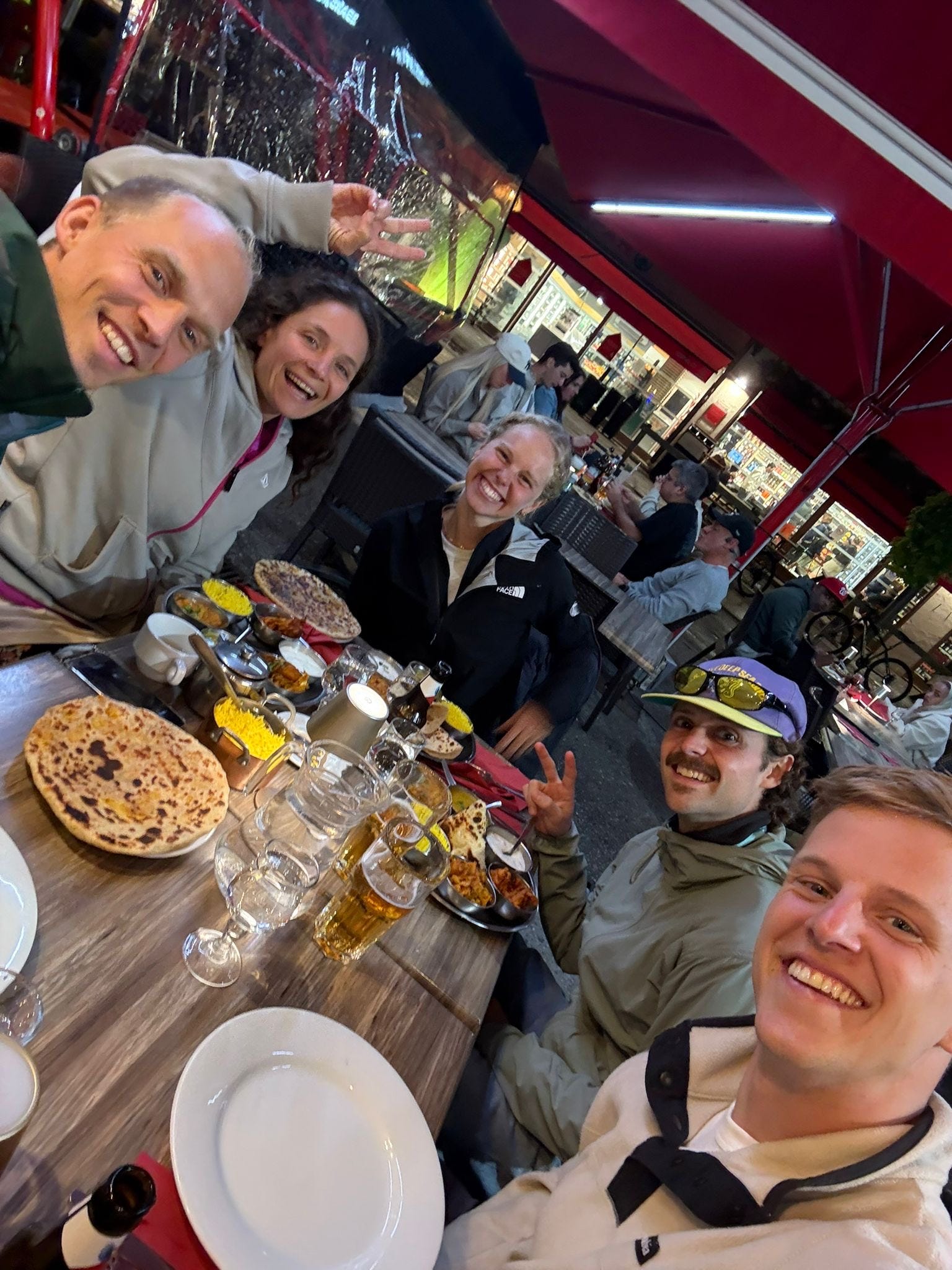
My team at Yanaa, a new sports nutrition company based in Annecy.
For more details check out their website there: https://yanaa.food/en
Looks like there has been some in depth self talk happened with yourself that led to this post.
Everybody has put on a mask and that too not in just corporate ladder. I see it everywhere in almost all of the families, b/w couples of any age. The amount of masks I see I want to live alone or is it just my immediate environment like this.
Just to put it I feel like I am stuck in some kind of ruckus. I don't want to live where I am living right now, I haven't started my professional career in Law in which I did my Bachelors. I have been living with my parents for the last couple of years since I graduated. Time has ticked away, doing chores at home, helping father in his business and doing tons of other things. And I keep saying to them you are not understanding that you people are taking a lot of time away & what good I can make out of my life when I haven't got adequate time. Now I have totally understood that they won't be able to understand and used to talk to my friends a lot that this isn't going right kind of things. I have stopped talking to my friends regarding all this stuff as I got a glimpse that they give advice and don't understand what kind of ruckus I am going through. There came a time when I stopped sharing it my sister as well even though she is the only person with whom I try to share the most. I don't know if I will get out of this turmoil, but I have to put in the work and have to take now agency for everything as nobody is going to understand and create the life I want.
I haven’t got multiple lives to live, as Confucius puts it We have two lives, the second begins when we realize we only have one.